
Interview with Artists Lee Baker and Catherine Borowski
Interview with Artists Lee Baker and Catherine Borowski
Founders of Graphic Rewilding
ART & MUSIC


Do you each have a personal movement or meditation or wellness practice? Does it influence your art?
Each of us has our own definition of wellness on a personal level. I practice reformer Pilates most days to move my body. I’m lucky enough to have an incredible teacher in the U.K., Ilana Rogol-Dixon, who ensures that every class feels like a journey of the body and the soul. I never know what to expect, except that she will take me through some cosmic experience and I’ll leave class feeling fabulous, transformed, and alive. Even if there is a lot of work to do, I know I have to exercise and breathe consciously. For me, happiness is a fusion of feelings: Pilates means moving my body, clearing my mind, and a good mood.
For Lee, the balance of mind and body is crucial to feeling in a good state. He sits all at the computer or canvas working, painting, and drawing, which in itself is a kind of meditation, especially when creating the sweeping calligraphic lines of the flowers.
We both love life drawing, there’s something extremely calming in sitting at an easel and creating on paper or canvas in silence. There’s no talking in the drawing studio because everyone is focused on the model, the lines, the perspective, and the negative space. It feels like a dynamic meditation. It’s one of the things we like to do and actually close to a meditation practice. It stimulates alpha waves in the brain and calms the brain.
We spend a lot of time dreaming up ideas, actively manifesting opportunities, and making shizz happen. Even when the opportunities are sparse, we make them up ourselves. If we don’t have a commission, that doesn’t stop us; we’ll set up our own lighting installation by poking our projector out of our studio or apartment building and lighting up the building opposite with our flowers. That sort of thing keeps us excited and busy.
What is your art background/training?
Both Lee and I went to art schools in the U.K. Lee specialised in painting and art history, and I specialised in sculpture and installation. Lee then spent the next few years in bands and as composer creating music for TV (all the time painting flowers in his studio). I became a producer/curator of public art and fashion shows.
We came back full circle to visual creativity after meeting on a flight to New York and bonding over our love of art, especially public art. From that point on we started working and creating together and soon started SKIP Gallery, a mobile exhibition space in a dumpster/trash can.
SKIP has become an ongoing series of collaborative, site-specific artworks housed in dumpsters in public sites, bringing unexpected eruptions of art into the everyday urban landscape. Since setting up SKIP, we have collaborated with some of the biggest names in contemporary art, including David Shrigley (Look At This, June 2017), Gavin Turk (Transubstantiation, November 2017), Richard Woods (Upgrade, June 2018), and Ben Eine, as well as ‘the world’s most artistic football club’ AS Velasca in Milan. We’ve curated over 24 shows in London, Milan, New York, Rotterdam, the Scottish Borders, and a Greek Island.
In 2021 as an artistic counterbalance to the severe lack of green space in cities, we co-founded Graphic Rewilding to create vast, flower inspired, attention grabbing, positivity inducing artworks and immersive environments in often-overlooked and under-appreciated urban spaces. Lee is responsible for creativity, and I am responsible for production and implementation. All of our works are hand-drawn by Lee, who is the color expert, whilst I bring my expertise in fabrication, making things happen, making sculptures, and working in public spaces.
Can you share more about the connection between mental health, nature, and art?
It’s been shown that a 20-minute walk in nature is enough to significantly improve your mood and reduce feelings of stress and anxiety. However, as nature becomes less available for many in urban environments, it’s also been shown that exposure to simple pictures of nature has a positive effect on the mind. For example, patients who have images of nature in hospital waiting rooms have lower levels of stress and anxiety. Though these images could never provide the same environmental and psychological benefits as real nature, we want to inspire people to connect and empathise a little more with the natural world, hopefully mitigating some of the negative effects of a lack of exposure to green space.
Can you share some artists who inspire you?
We are both inspired by Christo and Jeanne-Claude.
Catherine Borowski:
Martin Creed
Elmgreen and Dragset
Lee Baker:
Ito Jakuchu
Lee Ufan
Van Gogh
What is your process for creating large installation art works?
We always start with a place, all our works are site-specific and rooted in the community and place where they’re going to exist. We spend time getting to know an area, its people, and of course its flora and fauna. We create drawings of the flowers and colours we feel represent the commission and build from there. Our works vary wildly, sometimes we’re creating animated digital arrangements that get projected onto tall skyscrapers, designing sculptures, or at other times we’re painting real grassroots murals in under-loved areas of the city. We spend a lot of time working with technical partners on production, print and fabrication, and of course all works need to be 100% on the health and safety front.
How did the collaboration with lululemon evolve for Shanghai’s World Mental Health Day?
We had one of those life-changing phone calls (that I didn’t answer at first), inviting us to collaborate with them on World Mental Health Day, and to be honest, the partnership was a match made in heaven. We have a complimentary ethos and love of moving the mind and body.
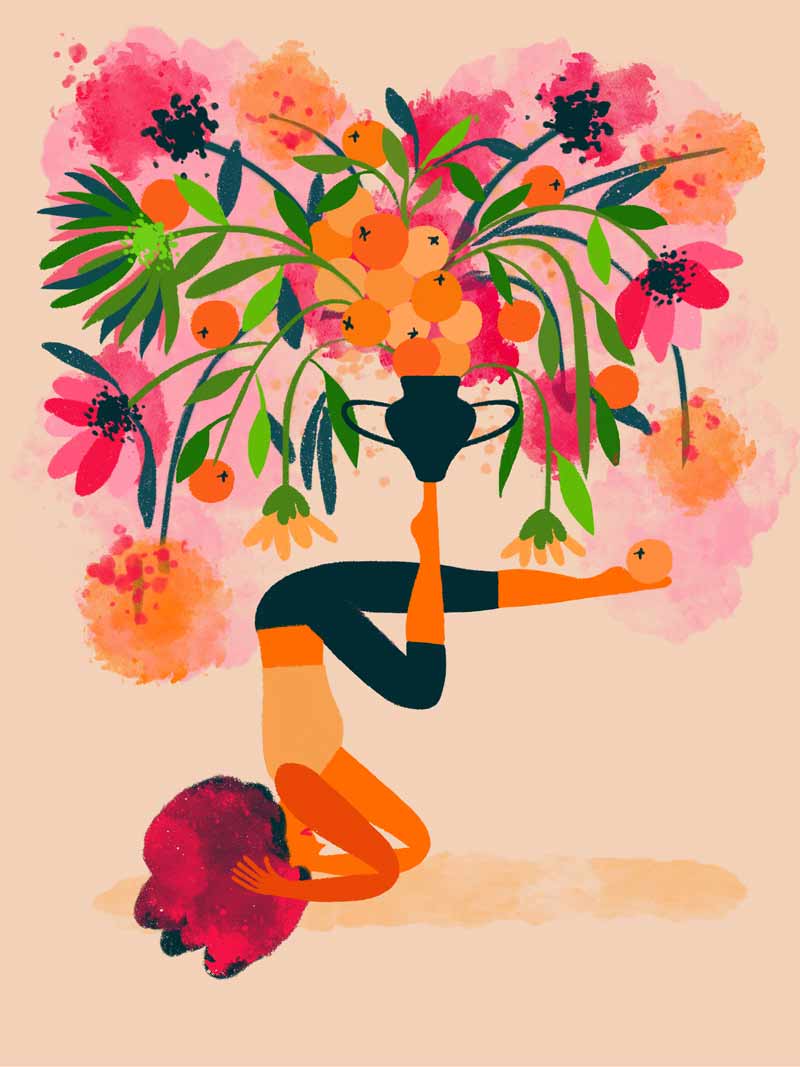
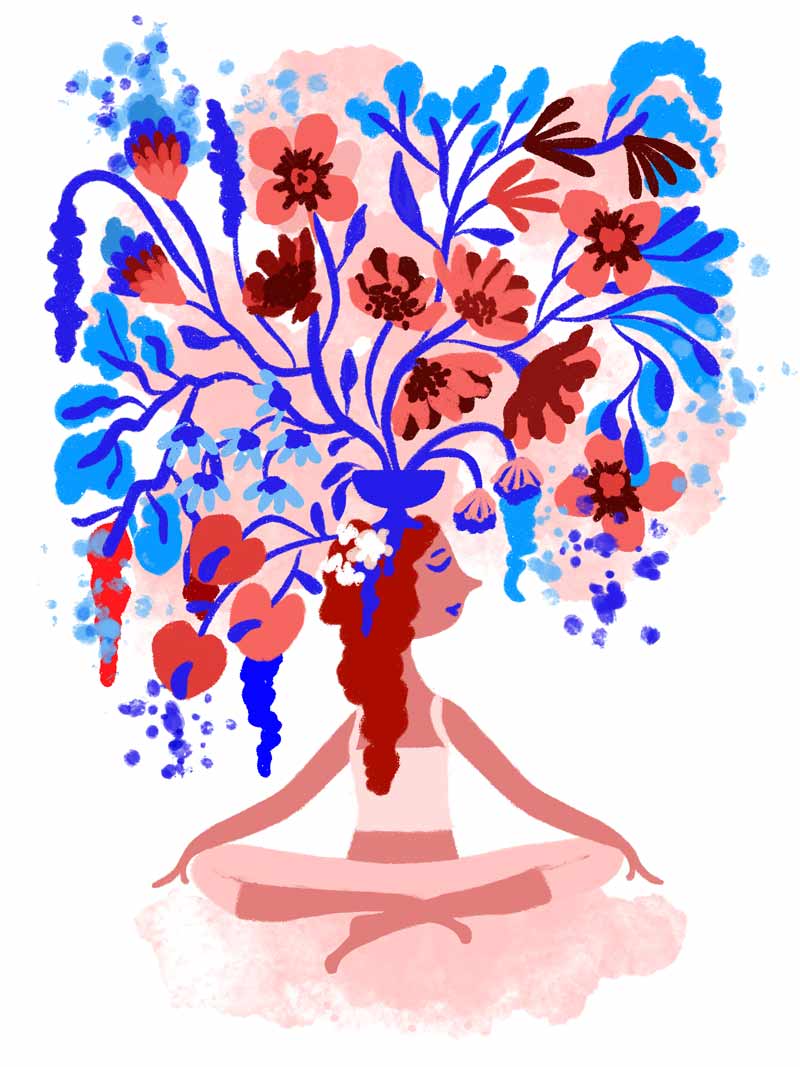
We created the concept of The Wellbeing Garden and worked closely with lululemon to bring our ideas to life. Each of the flowers we selected – iris, sunflower, torch flower, and chrysanthemum – represents a different movement/activity. Yoga, running, training, and recovery, each becomes its own space, an individual garden of our imagination.
Yoga
For this contemplative composition, we selected each flower to embody the essence of yoga — a practice rooted in harmony, growth, and the deep connection between mind, body, and spirit. The artwork serves as a botanical metaphor for the principles of yoga, weaving together the origins, the tranquility, and the transformative power of this ancient discipline.
Running
We chose these flowers to embody strength, speed and the pursuit of light. At the heart of this narrative are sunflowers and nasturtiums, plants celebrated not only for their rapid growth but also for their inherent quest towards the sun, mirroring the human race against time and our collective journey towards enlightenment and warmth.
Training
For training, these plants weave a narrative of growth, resilience, unity, and transformation, paralleling the journey of individuals dedicated to training and exercising. They symbolize not just the physical aspects of this journey, but also the mental and emotional growth that accompanies a commitment to personal health and well-being.
Recovery
These flowers celebrate recovery as an essential, beautiful, and natural part of the physical activity cycle. They remind us that growth, healing, and strength are nurtured not just through activity but through rest and care for the body and mind. This image serves as a visual homage to the quiet yet powerful process of recovery, highlighting the botanical allies that support and enhance this journey.
The images not only represented the characteristics of different movements, but also combined the ecological landscape of Xuhui Riverside Park, where the exhibition took place. For example, the fireflies seen in the Recovery space can be seen in the Riverside Park in the evening.
Alongside the visual aspect, we composed a bespoke soundscape, so when you enter the space you can hear the chirping of hummingbirds from near to far, the slight vibration of insects flapping their wings, and the ‘singing of flowers, all created using special technology to extract data from flowers and converts it into MIDI signals.
This series of works was beyond incredible, visiting Shanghai, realizing larger-scale murals and art installations on and in multiple epic buildings. To create art installations in a city with a highly technical and visually literate population is not an easy task. The bar is set so high, but we enjoy that challenge, it’s what we’ve been dreaming of.
You’ve collaborated on projects that range from wrapping paper to large urban installations, from London to China. What is your dream project and dream location to create your next art piece?
We’ve got some many ideas, some are locations we’d love to work in and others are specific ideas. We’d love series of high-rise apartments featuring our single stems all in a row, plus there’s a really long industrial building/factory on the coastal road from the airport to Reykjavik in Iceland which we would love to get our hands on. Locations include:
The Highline: New York
Naoshima ‘art Island’: Japan
Turbine Hall at Tate Modern: London
Arken Museum: Denmark
The Kunstsilo: Norway
Learn more: graphicrewilding.com