Yoga Plus Magazine Logo with white border
INTERVIEW WITH DR. STEFFANY MOONAZ

INTERVIEW WITH DR. STEFFANY MOONAZ

INTERVIEW WITH DR. STEFFANY MOONAZ

PH.D., CMA, MFA, C-IAYT, E-RYT 500
FOUNDER OF YOGA FOR ARTHRITIS


By: Megan Twining

YOGA

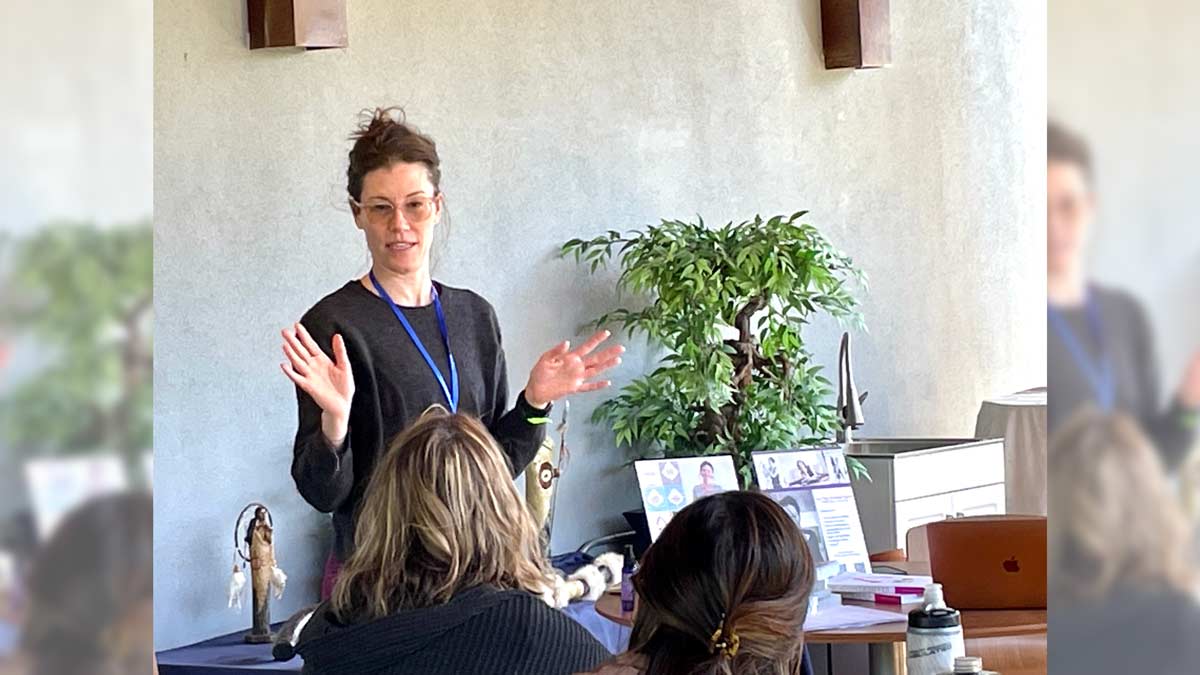
Every one of us has a different story of how we found yoga. Often, new students come to my studio,  Sonder℠, located in the Washington D.C. area, because their doctor prescribed yoga to manage the aches and stiffness that seem inevitable as our bodies change. This truth led me to seek out advanced training as a yoga therapist which is how I was introduced to Dr. Steffany Moonaz. She is the founder of the Yoga for Arthritis organization, a certified yoga therapist, professor and research director at Southern California University of Health Sciences. Her philosophy is that everyone should have access to feeling as free as a dancer, even as our bodies change. She calls yoga a ‘whole person practice,’ a successful method for pain management and a way to access what matters most – a sense of self as we age. 

Thank you so much for being a part of this interview for the Celebrating Age issue. Can you tell us about your professional roles and background? 
I’m the research director at Southern California University of Health Sciences which trains integrative health professionals. I research the use of yoga for arthritis, chronic pain, and musculoskeletal conditions. I am also the founder and director of Yoga for Arthritis, an organization that I started over 20 years ago. The landscape of yoga was very different then because there were not a lot of ways for people living with arthritis to access safe, accessible, appropriate, evidence-based yoga practices. I train yoga teachers and yoga therapists, provide yoga to people who are living with arthritis, mentor emerging professionals, and I advocate for access and a change in the conception of how we manage arthritis and chronic pain. 

I have a PhD in public health from Johns Hopkins School of Public Health, where I also worked in the rheumatology department. That’s where my training and background in arthritis and rheumatic diseases comes from. I also have a Master of Fine Arts in dance, which is relevant in the way I think about movement and the moving body and expression. I’m also a certified health and wellness coach, yoga teacher, and yoga therapist.

I love your connection to dance. You’ve mentioned the balance between stability and free range of motion that happens simultaneously in dance and yoga; can you elaborate on this?
In my memoir, Yoga Therapy for Arthritis, I quote a song that says, “Are we human or are we dancers?” Which is something that my son and I ask each other all the time. What we’re talking about is the otherworldliness, the different ways of being in the world. When you have access to that, it’s transformative. It doesn’t require any particular movement ability to find ways of relating to and being in embodied experience.

I know you spent some time in an ashram, and it was there you experienced real clarity about how to serve through yoga. Can you please share more on this?
There are many yoga teachers who do not intend to become yoga teachers; they pursue a yoga teacher training program out of a desire to dive deeper into their own yoga practice and their own experience of yoga, to learn more about yoga in a deeper, different way. I was one of those. So when others come to me for training and say, “I don’t really want to teach,” I chuckle. Yoga was the one thing that I did only for me. 

In my early 20s, I was teaching at multiple universities. I was already leading and training in a variety of ways, but my yoga was mine. I went to an ashram because I wanted to have an immersive experience of yoga. When you’re trained to be a yoga teacher at an ashram, you are immersed in the yogic lifestyle along with the yogic teachings for the duration. Since this and many other experiences after, I am certain of Divine guidance.

I never would have gone to that yoga teacher training to become a leading expert on the science of yoga as it applies to arthritis and chronic pain. But clearly, I needed that training along with everything else that happened since. It was because of that training that I was hired as a research assistant in the Johns Hopkins Arthritis Center. A researcher there took a yoga class and thought that it was really a powerful, viable option for the patients with arthritis in their clinic and needed somebody who was a yoga teacher to partner with in order to begin studying this. Going to the ashram gave me the tools that I needed beyond asana, the physical postures. In the West, a lot of times, that’s what we think about when we think about yoga. But it is such a small fraction of what yoga is, and being at the ashram allowed me to get a broader understanding of the expansive toolbox of yoga, so that when I did take it into the clinic, I could optimize its usefulness for the patients there and beyond.

You mentioned that arthritis is a “whole person” disease. What does that mean? I get the impression that everyone’s going to get arthritis to some degree or another as we age. I first want to say that when we’re talking about the arthritis that is associated with aging, we’re generally thinking about one specific form of arthritis called osteoarthritis. Osteoarthritis is the most common form of arthritis, and the prevalence of osteoarthritis does increase dramatically with age. Age is a primary predictor of osteoarthritis onset. Arthritis, though, is an umbrella term that includes over 100 different diseases, and it can affect people anywhere in the lifespan.
There is juvenile arthritis in many forms that can affect babies and toddlers all the way up to the onset of arthritis at the end of life and everything in between. Each of these forms of arthritis has different characteristics and different risk factors. If you are fortunate to live long enough, then your body tissue will start to age. What starts to happen is that we have cell turnover all of the time. Our body is shedding old cells and making new ones throughout the lifespan.

When we’re young, we grow more cells than we lose. That’s the growth that happens in early age. We have some homeostasis in the middle, where it’s an even balance. Then at a certain point, there’s more death than birth. We are losing connective tissue in the joints at a faster rate than we’re building it. We could think about that as being a natural consequence of aging, but there are reasons that it happens to some people earlier and more than others.

We are all losing connective tissue past a certain age, but not everyone feels it. Not everyone suffers from the experience of it because there actually is very little relationship between the amount of tissue damage and the symptoms that we experience. There are some people who have a lot of pain from very little tissue damage, and there are other people who have very little pain with a lot of tissue damage. You don’t go to your doctor about your knees unless they hurt. You may have what we would call pre-arthritic changes. There may actually be a wearing down of the cartilage in some of your joints, but because you’re not experiencing symptoms, it doesn’t really affect you.

And this gets to the “whole person” aspect of arthritis, because when you do have symptoms of arthritis, which for osteoarthritis the most prominent symptom generally is pain. But there’s also stiffness, swelling, fatigue, disability, and changes in the activities we’re able to do. All of this is different depending on the experience of arthritis, but also all of it can be changed without changing the tissue damage in the joint. While the experience of arthritis is a whole person experience, there are ways to address it that span all of the aspects of a person, too.

Oftentimes, when people hear that I study the effects of yoga for people with arthritis they go, “Oh, well, yoga is movement, and movement is good for arthritis. Arthritis is a disease of the musculoskeletal system. Movement is good for the musculoskeletal system.” What they fail to realize is actually what yoga offers to a person living with arthritis. Yes, it can directly affect the joints, but goes so far beyond changing the structure or the tissue and how it’s organized in the joint.

Can you share how yoga is a “whole person” practice?
Arthritis has no cure. It’s irreversible. You can’t build back the cartilage that you’ve lost, but you can strengthen the stabilizing muscles that surround the joint and help improve the integrity of the joint even while it’s losing tissue. We can slow the progression of the disease. We can also maintain physical function, even if we’re losing joint tissue. We can also use the tools of yoga to help change things like pain. People think of pain as being in the part of the body where you’re feeling it, but pain is actually a set of signals between the brain and the body. 

For example, if we’re talking about the knees, there’s a message that goes from the knee to the brain, that is the ascending pain pathway. Then there’s another signal that goes from the brain back to the knee, that’s the descending pain pathway. This is happening in the nervous system, not the cartilage, and there are all kinds of tools that we can use in yoga that change the functioning of the nervous system, including things like breath control. When we deepen the breath, we’re changing the state of the nervous system, which affects pain even if the cartilage doesn’t change. Tools of yoga can also help to lift our mood and can help change our mindset.

Do you have any success stories?
So many! There was one situation in a Yoga for Arthritis class at the Johns Hopkins Clinic with a patient who had a systemic inflammatory form of arthritis called rheumatoid arthritis, but she believed that she had osteoarthritis. The treatments are completely different, and she was not receiving the medical treatment that she needed. She was middle-aged and very disabled. She had a very difficult time getting around, let alone engaging in a physical yoga practice.

She was able to get down to the floor with some difficulty but could not get back up to standing on her own. One day, I walked over to support her and reached out my hand, and she waved me off without saying anything. It was clear that she wanted to do this herself. And so she was leaning forward, had one foot up, one knee down, struggling, but was finally able to bring herself up to standing. I was nervous about everybody staring at her struggling to get up, but as soon as she got to standing, the whole room burst out in applause.

It was such an important moment for her. It was the first time that she had been able to get up from the floor in as long as she could remember, and it also emphasizes the importance of community and support in that experience. 

If there were someone reading this that is suffering from arthritis and is looking at yoga as a potential means to help themselves, are there any pieces of advice? 
Something you can do immediately by yourself, without any assistance, is to breathe in a way that can help to manage pain. We all have experiences in our lives of using our breath to manage pain. We do it automatically, and don’t even think about it. An obvious example for anyone who has gone through childbirth, because you definitely are using your breath for pain management there. 

We can shift our energy by changing how we breathe. If you put a hand on your belly and a hand on your chest, you should notice that as you breathe in, your whole torso expands, and as you breathe out, it softens. The first thing is, if your belly doesn’t move when you breathe, change that. Some of us who are feeling stressed are breathing high up into the chest, we’re holding tension in our abdomen as a coping strategy, we’re not getting the benefit of full deep breathing. So that’s one way to start, just take deeper breaths, allow your belly to move. 

Another way is to slow down the exhale. Take a deep breath in and then let it out nice and slow, it helps to take us out of stress response into relaxation response. Stress makes pain worse, and pain makes stress worse. If we start breathing more deeply, and especially lengthening that exhale when we’re feeling stressed or when we’re feeling pain, you can feel an immediate shift in your state of being with just that simple technique. If there’s one thing that you’re going to do, it is to breathe more deeply. 

If you also want to get started with a yoga practice, with that whole big toolbox of postures and breathing practices, mindfulness, meditation, relaxation, applied philosophy, and all of the rest, you’re going to want a teacher. You want to look for a teacher who has training and experience working with people who have different needs, who have physical limitations. It can be called a lot of different things, yoga for seniors, chair yoga, or gentle yoga, but instead of just going by what the name of the yoga class is, contact the studio and ask, “Hey, I have arthritis. It’s hard for me to get down to the floor. Is this class appropriate for me?” Or, “I’m new to yoga, I’m a little bit older. Do you have a class that would be a good place to start?” If you can’t find a class that’s right for you, you might want to start one-on-one with a yoga teacher or a yoga therapist who can help you learn the basic skills of how to practice yoga at home, or how to go into a yoga class and know and keep yourself safe no matter what the instruction is that’s being provided.

If you try a class and it is not a good fit, don’t assume that there is no yoga for you. It’s the same when you go to a medical visit and you think “this is not a good fit.” You don’t give up on medical care, you go find someone else.

Is there anything else that you would like to share on the topic of “celebrating age.”
I think that it’s unfortunate that in our society, we tend to devalue the wisdom of older people. We have a lot of work to do to change that societally, but we can change that ourselves by appreciating our own wisdom as we age, by seeing all that we gain instead of only looking at what we lose. We’re gaining far more than we’re losing as we get older, and we can be such an asset to our families, to our communities. 

In yoga, there is this idea of different stages of life. And as we get older, we move from growing and developing as individuals to creating families, creating careers or creating households. Then we move into this stage of life that is stepping back and passing the torch to the next generation. Being mentors, being guides, being spiritually wise, intellectually wise. No matter what, you have a unique perspective to offer. Yoga provides a model for how we can show up as we get older in a way that is fulfilling to us and also useful to the world.

Learn more: arthritis.yoga

HOW TO BECOME A YOGA INSTRUCTOR: FROM TRAINING & BEYOND

HOW TO BECOME A YOGA INSTRUCTOR: FROM TRAINING & BEYOND

HOW TO BECOME A YOGA INSTRUCTOR: FROM TRAINING & BEYOND

Sponsored content from our partners at beYogi

YOGA
BIG BEAR YOGA FESTIVAL
Yes, yoga is huge — and its popularity is only growing! It really is a great time to become a yoga instructor.

The numbers don’t lie: Around 85,000 yoga teachers have been certified in the United States and a staggering 300 million worldwide, according to a 2019 report by Yoga Journal and Yoga Alliance. Just as the number of teachers is growing, so are the number of students interested in this often life-changing practice. Another survey in 2019 by Yoga Alliance estimated around 38.4 million Americans alone practice yoga.

Once you get called to sit in the teacher’s seat, you may wonder how to become a yoga instructor. There are many steps to work through as you begin this journey, which will be both challenging and rewarding for you and all the students you lead throughout your time as a teacher.


1. Understanding the Role of a Yoga Instructor

Before I completed yoga teacher training, I honestly thought being a yoga instructor involved just getting people in postures. I had no idea! The reality is that yoga instructors not only cue students through physical movements, but they also hold space for their emotional, spiritual, and personal development.

That said, the main role of a yoga instructor is to provide a caring and supportive environment for students to investigate and strengthen the connections between their minds and bodies. You must offer a safe space, through mindful cueing, as well as compassion and kindness. I always want my students to feel successful, even after the most challenging classes.

Yoga instructors must have excellent communication and planning skills, and they must remain aware and mindful before, during, and after each class.

They also need to be knowledgeable in what they are teaching. There are many different kinds of yoga, from yin to hot vinyasa to stand-up paddleboard yoga to chair yoga and so many more. If you are drawn to one style, you may consider additional training after your 200-hour teacher training to specialize your career path.


2. Personal Preparation

Not everyone who has completed yoga teacher training wants to learn how to be a yoga instructor, and that’s fine if you don’t want to teach. You may just want to deepen your personal practice.  Assess your motivations and commitment to sharing yoga with others before you plan to teach. When you know your “why,” you’ll be more likely to overcome any obstacles on your path to the teacher’s seat.

I personally practiced yoga for more than 10 years before becoming a teacher 13 years ago, but all you need is a strong personal practice and experience to be prepared. It’s also important to feel physically able as well as mentally able. If you’re struggling in your life, it might not be a good time to learn how to be a yoga teacher.


3. Choosing the Right Yoga Teacher Training Program

The biggest decision you’ll need to make is choosing the yoga teacher training program. I encourage you to choose an accredited certification program, like those partnered with Yoga Alliance. Everyone starts with a 200-hour course, although many committed teachers go on to pursue 300-hour and even 500-hour certifications.

As you begin your research, you’ll discover a wide variety of locations, styles, instructors, and costs. You may want to go to a destination and complete the training through an intensive three-week course, or your schedule may be better able to fit in a local course that stretches over 12 weeks or even a year. My advice is to not rush your training. Yoga teaching requires a lifetime of learning, and it can take time to integrate new concepts into your daily life and practice.

Learn more about the options with our Yoga Teacher Training Guide.


4. The Yoga Teacher Training Experience

I was right in that yoga teacher training would provide the practical steps instructors need to get students into safe postures, but that’s just the beginning of the experience. Topics in a good training program will include:

  •       Anatomy
  •       Spiritual philosophy, including reading texts like the Yoga Sutras and the Upanishads
  •       Proper sequencing and structure of classes
  •       Ethics
  •       Professional business and marketing strategies

This material will take as many hours as the course states: 200, 300, or 500. But as I mentioned, these hours can be packed into a few weeks or spread out over a year. These hours don’t include homework, and there will be lots to study! If you’re like me, you’ll find great joy in learning about yoga.

Yoga teacher training also always includes practice teaching with feedback from your instructors. It can be challenging to receive criticism, but it will help you be a better yoga instructor. Make sure to build a supportive community and network with your fellow trainees to lean on when the training gets challenging.


5. Obtaining Certification

To receive your certification, you’ll need to complete the required hours of training with one accredited school. This will likely include a written exam as well as leading your first yoga practice for the rest of the class. It’s a big accomplishment to complete this process, and you should be proud when you do!

Next, you’ll likely want to register with Yoga Alliance or another certifying agency as a yoga instructor. This will let your future employers know that you’re a professional who will uphold proper ethics.

Once you start teaching, you may consider adding on additional certifications. These can include continuing education in general yoga teaching or specialties. For example, I am certified in teaching chair yoga and SUP yoga, and I’m considering a certification in yin yoga. Keep learning along whatever path brings you the most passion and excitement.


6. Get Yoga Teacher Insurance

Even before your first class, look into getting yoga teacher insurance. The last thing you want is for someone to injure themselves in one of your classes, but it happens. It’s better to be prepared and covered with professional liability insurance.

Check out beYogi’s insurance coverage, as it’s a popular option with yoga instructors. You can sign up online in just a matter of minutes. It’s easy to choose from a list of yoga styles you plan to teach and coverage limits for your financial situation. You can also get umbrella coverage for a variety of bodywork and beauty practices that many yoga instructors add to their resume.

Plus through YOGA♥ Magazine you can get $20 off a professional insurance membership when you use our affiliate link.


7. Building Your Yoga Teaching Career

Once you have completed a 200-hour yoga teacher training, are certified, and insured, you’re ready to find a class! One of the best ways to do this is to simply sign up for classes at the studios, gyms, community centers, and online platforms that interest you. Talk with the owners and ask about availability in their schedule.

Create a resume with your training and interests. With time, you will have a portfolio of classes and a strong network within your local yoga community to help you find better opportunities.

Popular yoga teachers also market themselves on social media, but that’s just the start. You need to have a website, a logo, and a consistent style for your advertisements. If you are insured through beYogi, you actually get a free website as an added benefit to help you market yourself professionally.

Always look for new avenues to expand your reach to new students. Eventually, you’ll have a class of people who resonate with your style. It may take time but keep persisting.


8. Continuing Education and Professional Development

Teaching yoga can be a hobby, or it can be a career. You get to decide! The best yoga instructors, though, invest in their skills through ongoing learning and professional development.

Look for workshops, retreats, and advanced training opportunities that interest you. Stay up to date with trends in the industry and new practices. When you keep a “beginner’s mind,” you make it easier for your students to do so, too.

But yoga isn’t like other careers; instructors must invest in their personal development as well. Yoga teachers need to maintain a regular personal practice and take care of their needs. This can range from getting enough sleep to eating well to working with a psychologist. The more centered and content you are, the better you’ll be as a teacher.


9. Challenges And How to Overcome Them

One time when I was teaching preschool yoga, one of my students accidently went to the bathroom on his mat. They don’t teach you what to do then in yoga teacher training!

You’ll discover many obstacles during your training and in the following years as a teacher. Here are a few challenges (and solutions!) that I’ve experienced or learned about from my fellow instructors.

Challenge: No one comes to your class!

Solution: Have faith that you will find your students with time. You’ll learn your market and the desires of potential students, and you can adjust when necessary. Stay flexible on and off the mat!

Challenge: A more popular yoga teacher scheduled a class at the same time as yours.

Solution: Instead of comparing yourself with more seasoned yoga teachers, engage them as mentors. Consider offering a completely different style of practice: If they teach hot vinyasa, offer a yin class.

Challenge: A student might say something hurtful. One time a student actually told me he hated me for offering so many chaturangas!

Solution: Smile. Their practice isn’t about you, even if they think it is. It’s about them. If they are mindless in their speech, demonstrate extra compassion.

Challenge: You’re burned out. You may have committed to too many classes a week.

Solution: It’s crucial to make time for self-care and know when you’ve taken on too much. If you’re having trouble staying motivated or inspired, go back to the basics: Talk to the yoga teachers who ran your training or another instructor you respect. Reach out for help.

Challenge: You love teaching, but you’re simply not making enough money to pay the bills.

Solution: Depending on your location, the popularity of your classes, and whether you’re teaching in a gym or a dedicated studio, your pay can vary dramatically. Don’t be afraid to talk with your employers about pay and be ready to change locations if you can earn more.

Think of each hurdle as a necessary learning opportunity, because that’s exactly what it is.


10. Beyond Teaching: Expanding Your Career

Finally, this article on how to become a yoga instructor wouldn’t be complete without discussing all the complementary ways that you can leverage your training to enhance your career. The best-paying opportunities are private classes, workshops, and hosting retreats. Once you are confident in your teaching, you can expand and earn more.

You can also expand your career through specialization, such as therapeutic or prenatal yoga. I earned a lot more working as a standup paddleboard yoga instructor than I did teaching a more traditional class at the local gym, in part because SUP yoga requires additional training. Consider specialization as an investment in your future as a yoga teacher.

You can also use your knowledge like I do, as a professional writer! Not only do I teach four classes a week in my community, but I also enjoy writing, blogging, and creating online content. Not only is it possible to make additional income, but you can also use your work to market your teaching to more students.

And that’s really just the beginning. As you gain experience, you may want to lead your own yoga teacher training program. Maybe you have an idea for yoga-themed products, such as journals, straps, clothing, or even aromatic sprays.

Once you become a yoga teacher, you’ll have many opportunities to grow as a professional — and as a person.

3 YOGA POSES TO TRY WITH YOUR PARTNER TO BUILD A STRONGER BOND

3 YOGA POSES TO TRY WITH YOUR PARTNER TO BUILD A STRONGER BOND

3 YOGA POSES TO TRY WITH YOUR PARTNER TO BUILD A STRONGER BOND

Yoga Director at YogaRenew Teacher Training, Patrick Franco

Sponsored Content from our partners at YogaRenew Teacher Training

YOGA
YogaRenew Teacher Training

Finding precious bonding time with your partner can be difficult. Whether you set aside 10 minutes a day to connect or schedule weekly date nights, quality time creates a sense of closeness and should not be overlooked. One way to better connect with your partner is practicing partner yoga. You can deepen your stretches and relationship, all while having fun, with a playful partner yoga practice.

Partner yoga helps foster communication and connection.  It also builds trust and teaches us how to physically and mentally let go. It’s a completely different experience than rolling out your own mat and practicing on your own in silence. These poses require two people to work together to get the biggest benefit.

The poses can range from simple seated twists that are great for beginners to Acro poses that require a good amount of strength and flexibility. Whether you’re looking for a simple stretch to try or a challenging pose that’ll require a lot of mutual effort, read on below for three different partner yoga poses to try!

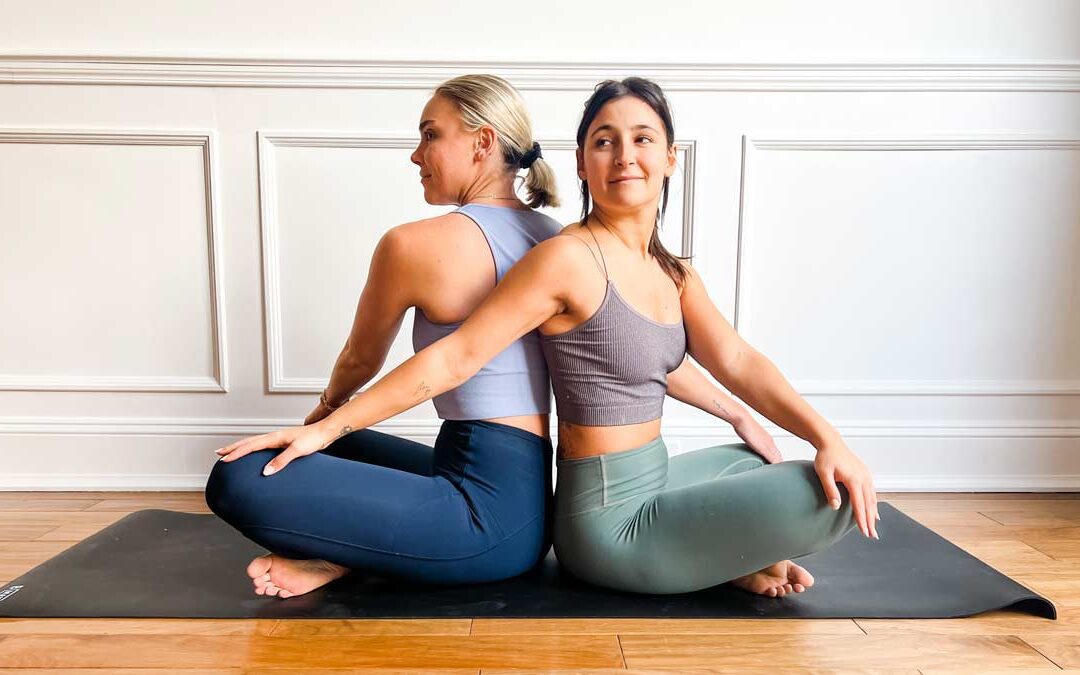
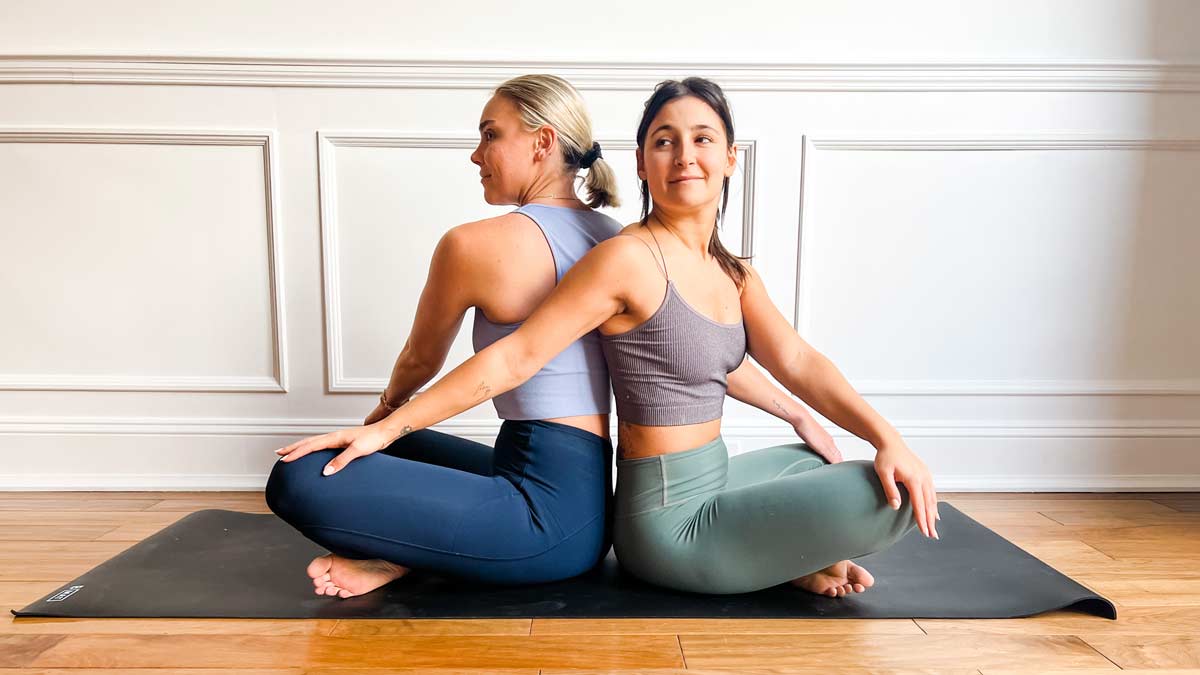
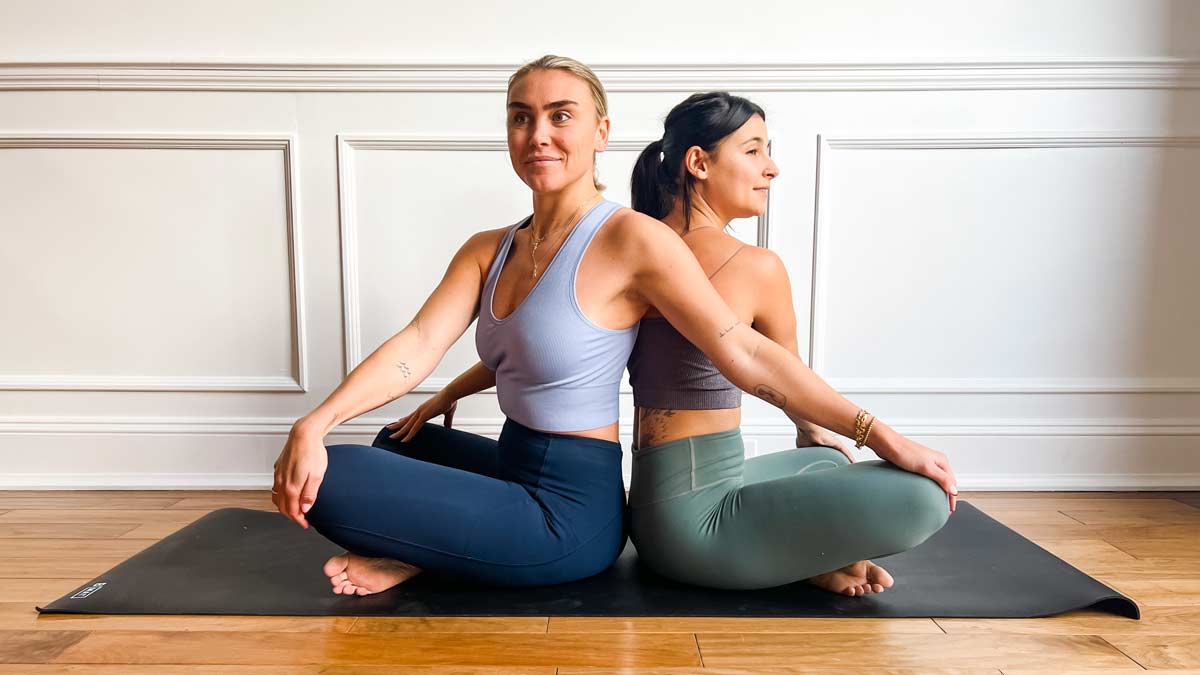
Seated Spinal Twist

This is a great “ice-breaker” partner pose because it is simple and everyone can practice it!

  • Both parties start seated cross legged, back to back
  • Both parties extend their arms into a T-shape and twist to the right holding the left knee of your partner and the left hand rests on your own right knee. Repeat twisting to the left.

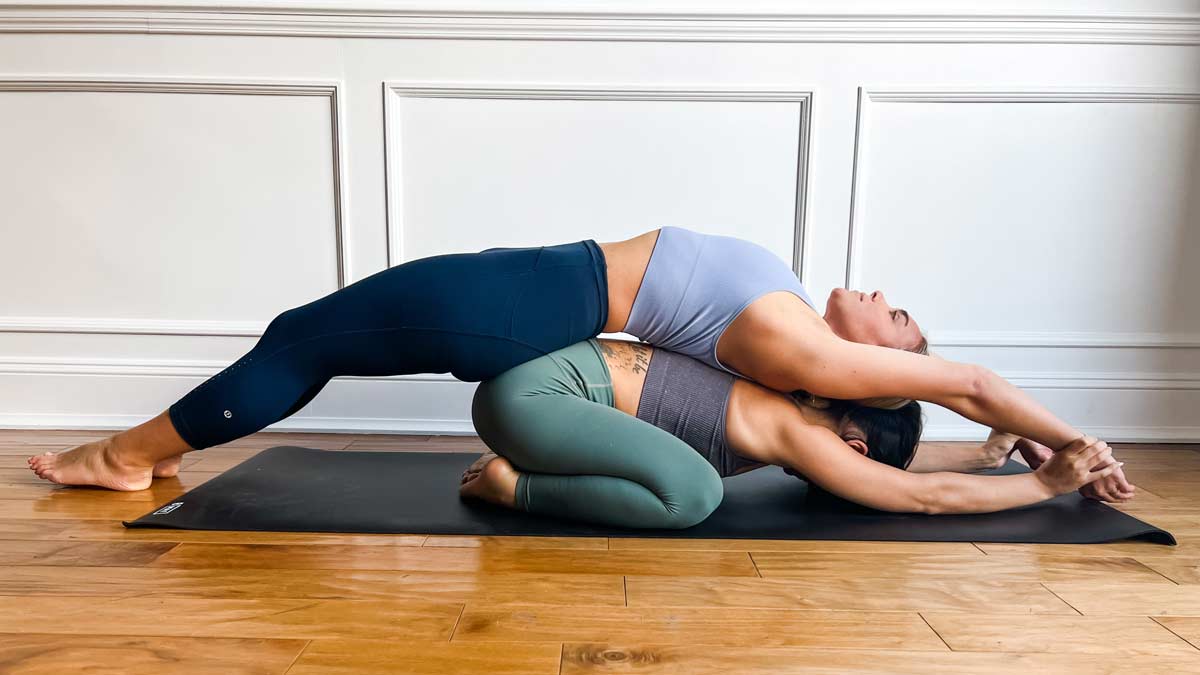
Lizard on a Rock

This pose is a little more complex but both students get a great stretch.

  • Student #1 starts in child’s pose
  • Student #2 sits sacrum to sacrum on Student #1 and extends backwards.
  • Student #2 extends arms overhead and Student #1 grabs their wrists for a deep stretch
  • Student #2 can extend their legs as well to get a full body stretch if comfortable
  • Switch positions

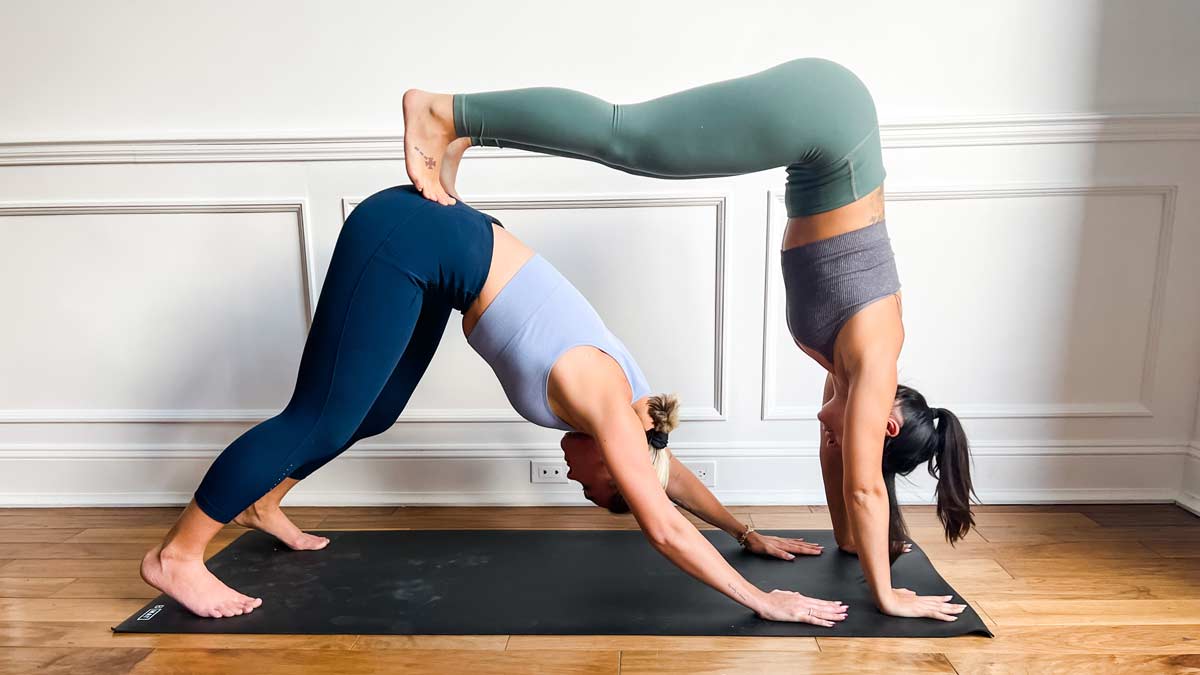
Down Dog / L-Shape Handstand

This is a classic partner pose that’s fun and playful and goes upside down!

  • Student #1 starts in downward dog
  • Student #2 places feet outside Student #1 hands and then places their hands on the floor
  • Student #2 takes one foot at a time onto Student #1’s sacrum (the triangular bone between the pelvic bones). Student #2 is in an L-Shape Position.
  • Student #2 has the option to lift up one foot and then the other as if practicing L-Shaped Handstand at the wall
  • Switch Positions

Thank you to our partners at  YogaRenew Teacher Training for sharing this fun sequence with our community!

Seated Spinal Twist

YogaRenew Teacher Training
Lizard on a Rock
YogaRenew Teacher Training
Down Dog / L-Shape Handstand
YogaRenew Teacher Training
WEAVING INSPIRATION TO THE HEART

WEAVING INSPIRATION TO THE HEART

WEAVING INSPIRATION TO THE HEART

By Ingrid Baquero @ingridsolbaquero

YOGA
WEAVING INSPIRATION TO THE HEART
Storytelling is a powerful tool to engage the heart. 

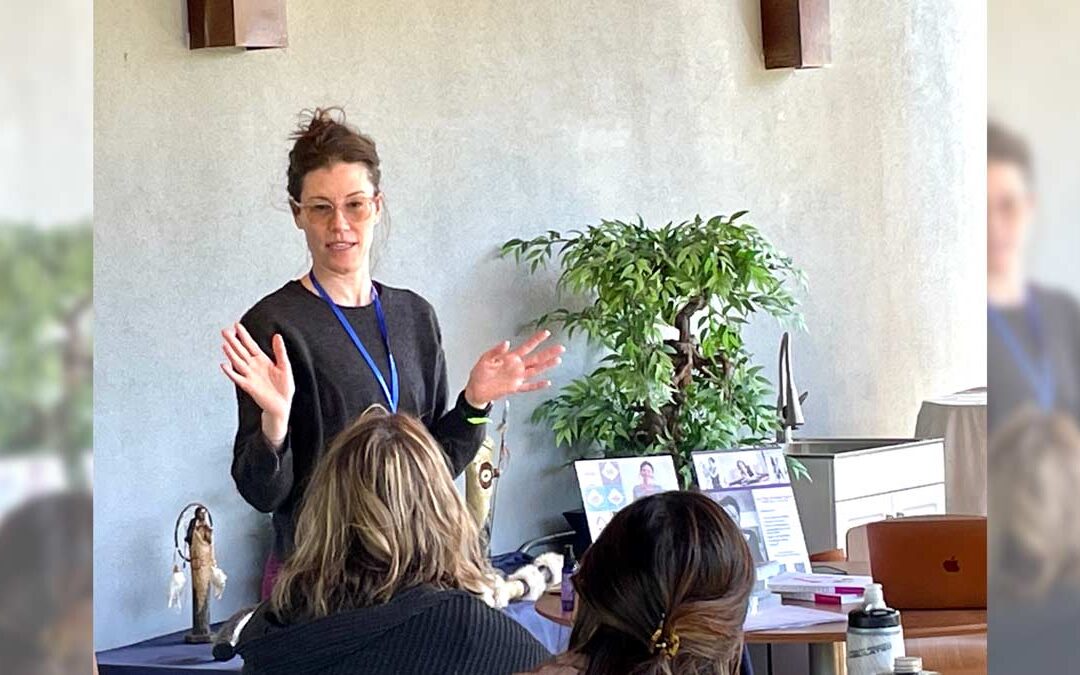
During the Sedona Yoga Festival this past April, I had the pleasure to sit in and learn from Rachel Scott, yoga teacher trainer and professional instructional designer, through “The Art of Theming,” workshop. 

In yoga, some teachers practice opening an emotional connection through dharma talk, centering students through a universal theme before the journey unfolds on the mat. The practice of dharma talk allows students to elevate their awareness and movement with a personal intention based on the theme provided by the teacher. 

Rachel shares that, “Theming provides a ‘why’ for the ‘what’, which then informs the ‘how’. It provides a pathway to bring heartfelt philosophy into the physical body, and provides us with a tangible way to live our yoga – both on and off the mat.” 

Weaving a theme into class might feel overwhelming, but if we take time to reflect as teachers, our everyday experiences can become relatable learnings to share with others, awakening the Shakti energy in our students beyond just the physical asana practice. 

Rachel’s workshop provided a helpful process with questions to guide teachers on theming and inspiring the heart. Here’s what we learned to create a positive ripple effect through sharing our own experiences. 

The Story: What’s your story? What is life teaching you right now? Reflect on a recent experience that taught you something. Share your short story, and make sure it has a relatable context for others. It must be a resolved experience. Very important! Our story is to be of service for others for positive learning. 

The “AHA,” moment from an “I,” standpoint:  What did I learn from this experience? Be specific on your theme. Some examples: Be Present. Listen to the Heart. Accept Surrender. 

The “Find the Light,” from a “We,” perspective: How is my reflection a universal truth learning that can apply to all? We all go through similar experiences that make this theme relatable. What should we keep in mind?

The Application & Tools: How can this theme be expressed through language, mudras, poses throughout the physical or philosophical practice? Create a theme toolbox.  

The Close: Reiterate your theme with a closing statement. Could be a quote, a gesture, or a closing mediation that channels your theme. 

Overall, theming is a creative and meaningful way to connect with your students. 

Rachel is launching several “Summer School” opportunities. Check out her 4-month long Sequencing Mentorship, the 60-Hour Program, Integral Anatomy for Yogis, or her full 300 hour YTT.  To find out more, check her website and follow her on IG @rachelscottyoga.

Happy weaving! 

PRACTICING FOR LIFE’S DIFFERENT STAGES

PRACTICING FOR LIFE’S DIFFERENT STAGES

Practicing For Life’s Different Stages

By: Jai Sugrim
Photos: Chas Kimbrell
YOGA
Jai Sugrim is a Yoga Teacher, Athletic Trainer, Public Speaker, recognized Men’s Health Expert and creator of the Jai Sugrim Method

We are the first generation to be able to see what thirty years of a consistent, physically demanding yoga practice produces. Some folks look rested, bright, agile and positively energetic. Others look ragged, dry to the bone, exhausted and hobbling. Some of this boils down to genetic predisposition and lifestyle choices like rest, nutrition and sleep. We should definitely keep an eye on adapting our practice to each new decade of life. Wisdom is the trimming away of the un-essentials. 

Vinyasa yoga is a very attractive form of exercise that has numerous physical and psychological benefits. The practice hones our attention, and when done consistently, can be deeply revealing. In New York City, as in any large metropolis, it’s easy to pour the addictive side of our personalities into the practice and pursue poses like rungs on the career ladder. Most practitioners have gotten carried away with the physical side of the practice at some point. After injury, or total exhaustion, we may ask ourselves: “What is the right way to practice, for the current stage of my life?” At age 42, I’ve made every practice mistake in the book. After 18 years on the path, I have started to adapt the practice to a new goal: living a long, healthy, mindful life. I practice fewer asanas, vary my physical exercise movements, and sit in daily meditation. Here are my tips and what to consider for the evolution of your practice: 

INTELLIGENT DESIGN 

For a decade I practiced 4 hours of asana, daily. Now, I’ve shifted my approach to reflect positive aging, with a focus on long-term bone health and muscle strength. I now practice 5 hours of vinyasa yoga, 2 hours of weight-training, 2 hours of martial arts, and one dance class, per week. This kind of periodization is a systematic planning of one’s physical training through the arch of a year. To avoid exhaustion, injury, and mental fatigue it involves zoning in on one part of the year devoted to peak performance. Different phases are divided with different goals. I intentionally allow the body to pack on 10 extra pounds of weight in the winter, while running 2-3 times per week in the summer to lower my body fat percentage to reflect peak fitness and extra self-discipline. Then I let it go. I’m no longer trying for personal records. My aim is to harmonize strength, endurance, flexibility, brain health, and physical balance, while respecting the body’s need for rest. 

AGE 

Ride the physical peak, if you feel inclined to do so! From puberty to the mid 30’s most people go beast mode. Once adapted to training, the body recovers well from hard practices as well as injuries. When I worked with the New York Yankees, we called age 33 onwards the “back stretch of a guy’s professional career.” For most athletes, this is when their pitches slow down and agility declines. It’s important to recalibrate after age 40. Everyone after 40 should incorporate weight training, because it maintains bone health, tendon strength and muscle mass, which declines with time. The consequences of over-training or moving inappropriately are greater after 40. Youth forgives many training mistakes, but men and women over 40 carry less testosterone and the body does not heal as quickly as it once did. 

CONSTITUTION

Initially, I’d advise approaching yoga practice with skepticism, become a tourist, and visit several schools. You will find a yoga style that moves your heart, and more importantly, fits your constitution. You may be drawn to the mantras, meditation and vegetarian diet associated with Jivamukti Yoga. Personally, I find Iyengar yoga too intellectual as a daily practice, but use it as a supplement to my Ashtanga practice. In order to dig the well very deep, and find water, it’s best to stick with one style. 

ANCESTRY

Additionally, look over your shoulder and explore where your ancestors lived. You are likely to perform best with the foods that match the region your genes spring from. Anyone hawking a one size fits all training or nutrition program is selling a false bill of goods. Constantly experiment, and listen to the body for feedback. It’s best to select locally grown/raised food, so as to adapt your immune system to the pathogens of your area. 

VOCATION

Some folks have jobs that require more physical energy, while others are sitting at a desk and using more mental energy. Our brains burn about 30 percent of all calories consumed, but our lower backs, biceps, quadriceps and core muscles are firing differently. If you work in an office all day, a 90 minute vigorous vinyasa class may reconnect your head to all four limbs and the axial skeleton. The key is to think of how to appropriate your energy. 

NEW MOVEMENT

Asana practice is more or less linear, with lots of repetition. This allows us to deepen our flexibility and develop a personal relationship to each pose, with regard to our specific anatomical proportions. All good stuff, but it comes at a price. Once we master a specific set of movements, the brain undergoes “synaptic pruning,” a process by which extra neurons and synaptic connections are eliminated in order to increase the efficiency of neuronal transmissions. In order to engage and maintain neuro-plasticity (the ability of the brain to form and reorganize synaptic connections throughout life), we should always be practicing some new form of movement that we have not mastered. Supplements to an asana practice could be, salsa dancing, basketball, martial arts or even juggling. When we are learning something new we engage the primary motor cortex of the brain, which is responsible for the preparation of movement, the sensory guidance of movement, the spatial guidance of reaching, and the control of trunk muscles in the body. So always study something new for long-term brain health and plasticity. 

PATIENCE

Asana practice is preparation for sitting still. It makes us comfortable enough in our bodies so we can meditate. If you have been practicing asanas for over 10 years you should be able to sit still for 20 minutes twice per day. If you don’t want that, that’s fine my point is that there is no need to overemphasize the physical, or remain attached to hundreds of poses for a lifetime. When I turned 40 I gave myself permission to put on 15 pounds of muscle, and parted ways with some asana such as Marichyasana D, Pashasana, and Kapotasana. I’m content with Mari B, Ardha Matsyendrasana, and Urdvha Dhanurasana. The vigorous, high volume vinyasa practice of my 30’s had done its job. I now practice more meditation and fewer postures, which yields extra energy that can be applied towards my creative work. One of the biggest lessons I’ve scooped on the path is to be flexible and treat myself with respect. A wonderful meditation practice that pairs well with asanas is the Buddha’s technique, Vipassana. Like asana, it is sensation-oriented, and centered around what is happening in the body/mind system at the moment. 

LOVE

Even the times where I got injured, tried too hard, thought I knew it all, or taught beyond my experience, are all worth it. I now accept the mystery of “not knowing” and the wisdom that comes from embracing all the parts of myself. I’ve learned to maintain healthy boundaries in my personal and professional life. So much of who I am today, is a result of all the blood, sweat and tears that were shed on my mat for two decades. I am more reverent than ever for the practice and am grateful that I have two arms and legs that allow me to continue the exploration. Practice creates an involution of energy and awareness. What you find there, in inner space is between You and infinity, your karma, and the capacity to interpret your experience. It is very personal. Be loving towards yourself, and allow long-term thinking to shape your approach to the practice.


Jai Sugrim is a Yoga Teacher, Athletic Trainer, Public Speaker, recognized Men’s Health Expert and creator of the Jai Sugrim Method. For more visit jaisugrim.com

Jai Sugrim is a Yoga Teacher, Athletic Trainer, Public Speaker, recognized Men’s Health Expert and creator of the Jai Sugrim Method
Accessible Yoga

Accessible Yoga

Accessible Yoga

By: Lauren Cap
Photos: Sarit Z. Rogers
YOGA
accessible yoga wheel chair yoga

Jivana Heyman, founder of non-profit organization Accessible Yoga, gives readers a gentle nudge to step into a safe yoga practice that fits the needs of any person in his book, Accessible Yoga: Poses and Practices for Every Body. With compassion and years of experience, we are guided into an accessible yoga practice, literally for every body. Yoga Editor for NY YOGA LIFE magazine, Lauren Cap had an opportunity to chat with Jivana right before the pandemic in early 2020, and shares her interview below.

I first want to thank you for creating Accessible Yoga to make yoga available to all communities with various physical abilities. It’s important to have information like this at our fingertips to remind everyone that yoga is most importantly about feeling good, not looking good.

Thank you for your interest in Accessible Yoga, and for your awareness that yoga is really about feeling good, not about how you look or what kind of poses you can do. It’s unfortunate that the image of yoga in the media is so limiting when the benefits of yoga are so powerful and are available for everyone. In fact, I often think of how it’s those of us who are struggling the most who can really benefit from yoga.

I came to yoga to help me deal with the pain and stress in my life, and I’m so grateful for how yoga has given me tools to help me with the challenges of being human. I feel like I owe a debt of gratitude to give back in some way, and my mission is to challenge those limited ideas we hold on to about what yoga is and how it works.

The most important thing for people to understand about yoga is that it is primarily a mental practice – working with the mind to reduce stress and connect with the essence of who we are. I often say, “Yoga isn’t about having a flexible body, it’s about having a flexible mind.” With that deeper understanding of the practice, it’s easy to find ways to make all the practices of yoga accessible, whether we’re talking about the poses, breathing practices, relaxation techniques or meditation.

The use of pose orientation in this book is very creative as we are able to maintain the elements of the traditional practice while offering an accessible way to receive the healing benefits of yoga. How do you empower practitioners to look beyond their physical limitations and feel confident in their Accessible Yoga practice?

I think knowledge is power, and one of the challenges in yoga is that there’s this feeling that the classical poses can’t be adapted or somehow they lose their power. Most of the poses we’re practicing these days evolved over the past few hundred years. It’s really the philosophy, meditation and breathing practices that are most ancient. The more people understand the underlying benefits of individual poses, the more they can find those benefits in different variations. That’s the way I’ve organized my book – trying to help people look beyond the superficial appearance of a pose and consider why they’re doing it. The “why” of a practice is the key to adaptation and accessibility.

What are some challenges you’ve witnessed from students who may be reluctant to a practice that doesn’t resemble what they see on social media or magazines? How do you work with your students to identify those needs to create a safe space of acceptance?

Safety and acceptance are the two most important elements of a yoga class. I want people to feel like they belong in the space, and that they will be safe – physically and emotionally. In order to do so, I often directly address the misrepresentation of yoga in the media. I try to teach my students about what yoga is – working with the mind to connect with the heart.

The main challenge that comes out of the misrepresentation of yoga within yoga classes is the idea that more is better. I constantly see students straining and potentially injuring themselves. It can take experience to learn about how far to go into poses and how long to hold them. I worry that with the competitive nature of our Western culture, many people are getting hurt in yoga. I also worry about the emotional suffering that people experience in yoga classes – feelings of not being good enough, or that they don’t belong.

There’s a common phrase, “The students are our teachers.” Along with your extensive training and experience, do many of these sequences and alternative practices come from practitioner feedback?

Yes, pretty much everything I teach comes from collaborating with my students and from other teachers who have inspired me. A key element of accessible yoga is collaboration, which is based on the idea of seeing the student as your equal and lifting them up. The traditional teacher/student hierarchy can be disempowering and lead to many problems, including much of the abuse we are seeing in the yoga world.

Collaboration is a key element in my teaching because it asks the student to step into their inner wisdom and sharpen their awareness. It can help them take on their yoga practice in a more profound way. In many ways, my goal is to make the students independent yoga practitioners who aren’t reliant on me. The more they feel that they have their own practice the more yoga will become an important part of their lives.

How has your personal practice changed over the years from when you first started?

I’ve been practicing yoga intently since I was in my early twenties, and now I’m in my early fifties, so a lot has changed. As my body ages, I try to find a practice that is supportive of my wellbeing in every way. When I was younger I would push myself into some of the more gymnastic poses, but after a lot of injuries, I’ve finally learned my lesson.

Nowadays, I don’t plan what I’m going to do when I get on the mat. I like to take a moment to notice how I’m feeling and consider what will be most supportive of my body and my mind in the moment. In fact, my mental state may be the most compelling part of my daily practice. I ask myself, do I need a more inward, slow, gentle practice with restorative poses and longer pranayama? Or do I need a faster, fun practice with music? Is there a part of my body that needs to be protected, strengthened, or stretched? Each day is a new adventure.

I realize that for a new practitioner that might be too much to take on. In the beginning it’s fine to do the same practice every day and notice how it feels. Gaining sensitivity to what’s happening inside your body. Introspection is an essential skill that comes with practice. Also trying out all different styles is a great way to learn about all the different tools that yoga offers.

What has surprised you the most since founding Accessible Yoga?

I’ve been most surprised by the incredible reaction I’ve gotten, and how much this work resonates with so many people who love yoga deeply. A big part of the mission of Accessible Yoga, the non-profit, is to support yoga teachers who are making yoga accessible. I’ve been amazed by the work that yoga teachers are doing all over the world. These are teachers who are serving day after day to bring yoga to communities that have been disempowered or underserved. They are often serving without recognition, and sometimes without even getting paid!

Wherever I travel, I meet yoga practitioners and teachers who have found the power of yoga and are sharing it with others. Their dedication and service is what propels me to continue to work for greater understanding and to break down barriers to access. All the issues that limit access to wellness also limit access to yoga – racism, sexism, ableism, homophobia, transphobia, etc., are all issues in the yoga world.

Physical adjustments in class has been a hot topic recently. To quote you, “Ongoing consent means that just because a student gives you consent at one point in class doesn’t mean that you have consent to touch at another time…Ongoing consent means that we open up a dialogue with our students during class…you can create an environment where declining touch is accepted and even celebrated, where students are learning to connect with themselves and speak up for what they need.” Do you have any additional comments on this topic?

It’s very important that we have more discussions in the yoga community about the lack of consent for touch that is happening in a lot of classes. Most of us weren’t trained in how to gain consent from our students, and we assume that hands-on adjustments are what the students want. I think we’re just starting to address this issue as a community, and I’m sure we’ll see more policy changes in the coming years to create more clarity around this topic.

The first thing we need is a clear scope of practice for yoga teachers, as well as a thorough code of conduct. We currently don’t have either, and it means that many yoga teachers are offering touch, adjustments and other practices without appropriate training. It also means that as a community we don’t have clear guidelines to follow to keep students safe.

Ironically, the real power of yoga resides in its ability to calm the mind and allow us to turn inward. I think we need to turn to the heart of yoga, which is already accessible, in order to make the practice safer and more effective for all our students.

Learn more: jivanaheyman.com

accessible yoga chair yoga